


You get your lab results back, and there they are: HDL and LDL, sitting side by side with numbers you're not quite sure how to interpret. Which one should be high? Which one should be low? And does "good" and "bad" cholesterol actually mean what it sounds like?
Understanding the difference between HDL and LDL matters more than just knowing the labels. It shapes how you read your own results, when you should pay closer attention, and which changes actually move the needle on your heart health.
What Are HDL and LDL, Exactly?
HDL (high-density lipoprotein) and LDL (low-density lipoprotein) aren't chemically different "types" of cholesterol. They're lipoproteins — carriers that transport cholesterol through your bloodstream, since cholesterol itself can't dissolve in blood on its own.
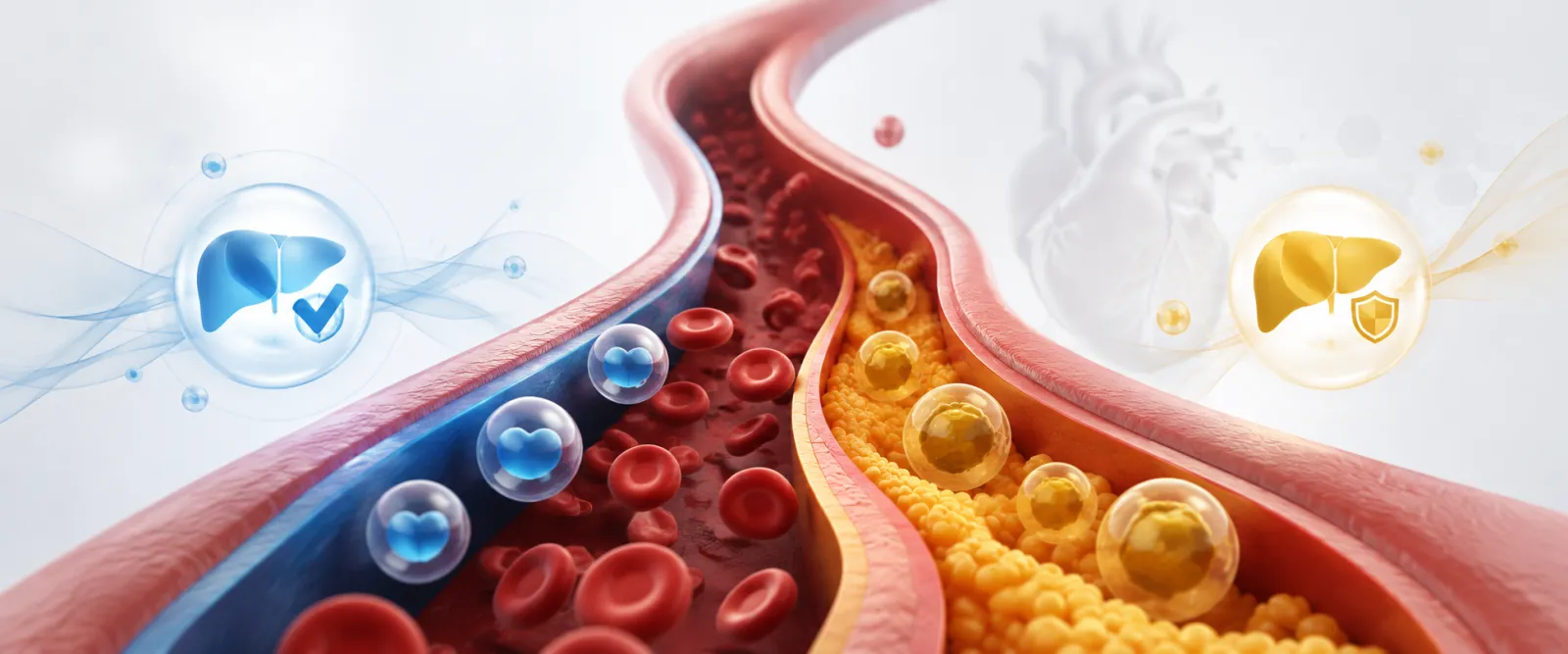
The difference lies in direction and function. LDL carries cholesterol from the liver out to the body's cells. When there's too much of it circulating, some LDL particles can get deposited in artery walls, contributing to plaque buildup. HDL works in the opposite direction — it picks up excess cholesterol from tissues and carries it back to the liver for processing and removal.
What's the Difference Between HDL and LDL?
Aspect | HDL | LDL |
Name | High-Density Lipoprotein | Low-Density Lipoprotein |
Main function | Transports excess cholesterol back to the liver | Distributes cholesterol from the liver to body tissues |
Direction of transport | Tissues → liver | Liver → tissues |
Link to cardiovascular risk | Low levels are associated with higher risk | High levels are proven to contribute causally to atherosclerosis |
Why Is LDL Called "Bad" Cholesterol?
Not because LDL is inherently harmful — your body actually needs it to build cell membranes and produce hormones. The problem arises when LDL levels stay elevated for a long time.
Evidence from genetic studies, epidemiological research, and randomized trials consistently shows that LDL cholesterol has a causal relationship with the development of atherosclerotic cardiovascular disease, not just a correlation.[1] That means lowering LDL doesn't just improve a number on paper — it genuinely reduces long-term plaque buildup in the arteries.
Why Is HDL Called "Good" Cholesterol?
HDL earns its "good" reputation because of its role in clearing excess cholesterol from body tissues, including artery walls, and ferrying it back to the liver — a process known as reverse cholesterol transport.
It's worth understanding that "good" and "bad" are simplified, public-friendly labels, not a fully accurate biological picture. Lipoprotein function is far more complex, involving multiple particle subtypes and interactions with the body's inflammatory processes. So, while HDL is generally protective, an extremely high HDL level doesn't automatically mean "the higher, the better."
Which Matters More: Low LDL or High HDL?
This is where a lot of confusion comes in, and the answer deserves some nuance. According to ESC/EAS guidelines, the primary focus of cardiovascular risk management today is lowering LDL-C, because the evidence for its causal role in heart disease is far stronger and more consistent than the evidence for HDL's protective role.[2]
Artificially raising HDL through certain medications hasn't consistently translated into lower cardiovascular risk in clinical trials. Lowering LDL, on the other hand — whether through lifestyle changes or medical therapy when needed — has repeatedly been shown to reduce heart attacks and strokes.
So if you had to prioritize one thing, keeping LDL low is the strategy with the strongest scientific backing. That doesn't mean HDL is irrelevant — it remains a useful marker of metabolic health — but LDL is the primary target in cardiovascular prevention.
How Can You Keep Your Cholesterol Profile Healthy?
The encouraging part is that many of the factors influencing HDL and LDL are within your control:
Swapping saturated fats for unsaturated ones (olive oil, avocado, nuts) tends to lower LDL.
Regular physical activity, especially aerobic exercise, is linked to higher HDL levels.
Quitting smoking can raise HDL within just a few weeks of stopping.
Maintaining a healthy weight supports overall lipid balance.
Cutting back on added sugar and refined carbs helps manage triglycerides, which also affect your broader lipid profile.
These changes take time to show results — usually weeks to months — and the outcome varies from person to person depending on genetics and other health factors.
For a deeper look at the causes of high cholesterol and both natural and medical strategies to lower it, check out our comprehensive guide on high cholesterol.
FAQ
Is high HDL always a good thing?
Not necessarily. Higher HDL is generally protective, but extremely high levels don't automatically mean lower cardiovascular risk — HDL's function is more complex than a single number suggests.
What LDL level is considered too high?
There isn't one universal cutoff — the LDL level considered risky depends on each person's overall cardiovascular risk profile. Your doctor determines your target based on your health history and other risk factors.
Is low HDL dangerous even if LDL is normal?
Yes, low HDL is still associated with increased cardiovascular risk even when LDL falls within a normal range. It's worth discussing with your doctor rather than dismissing it.
Can HDL and LDL improve without medication?
In many cases, lifestyle changes — diet, exercise, quitting smoking — can meaningfully improve both HDL and LDL. In some situations, particularly with strong genetic influence, medical therapy may still be necessary.
What causes LDL to suddenly rise?
LDL can rise due to dietary changes, reduced physical activity, weight gain, stress, certain medical conditions like hypothyroidism, or a combination of these factors.
Is exercise more effective for raising HDL or lowering LDL?
Regular aerobic exercise tends to be more consistently linked to higher HDL, while dietary changes usually have a bigger impact on lowering LDL. Combining both gives the best overall result.
References
- [1] Ference BA, Ginsberg HN, Graham I, et al. Low-density lipoproteins cause atherosclerotic cardiovascular disease. 1. Evidence from genetic, epidemiologic, and clinical studies: a consensus statement from the European Atherosclerosis Society Consensus Panel. European Heart Journal. 2017;38(32):2459–2472. doi:10.1093/eurheartj/ehx144
- [2] Mach F, Baigent C, Catapano AL, et al.; ESC Scientific Document Group. 2019 ESC/EAS Guidelines for the management of dyslipidaemias: lipid modification to reduce cardiovascular risk. European Heart Journal. 2020;41(1):111–188. doi:10.1093/eurheartj/ehz455
Disclaimer
This article is intended for general health information and does not replace professional medical consultation, diagnosis, or treatment recommendations.